Surfing & the journey of a wave
History of Surfing
While the history of surfing warrants another article and deep-dive across the histories of Peru, Hawaii & China, I will briefly touch upon the modern history which is probably closest to the current form of surfing we see today. Surfing finds a mention in the diaries (1778) of Captain Cook as an “Recreational exercise” by the indigenous people of Polynesia (predominantly in Hawaii). Christian missionaries found Surfing immoral & banned it & Colonialism brought diseases that wiped out close to 90% of Hawaii’s indigenous population- Yay Colonialism! Among vastly more important effects, was the dwindling of this recreational exercise. Only to be later revived by the efforts of Duke Kahanamoku (Early 20th century) & improvements to Surf boards & associated tech (wetsuits etc) by the Californian surfer dudes
Journey of a wave:
This is one of the parts I was most curious about, mapping out the journey of a wave from the deep sea to the coast. The mechanics of a wave are way cooler than just saying the winds cause waves- although if you had to summarize it like this you wouldn’t be incorrect. What I’ve understood so far is that ocean waves originate primarily from the transfer of wind energy to the surface of the ocean, first generating wind waves that can later organize into swell. Factors such as wind speed, wind duration, and fetch determine the range of waves that form, while differences in wavelength and period influence how fast they travel across the ocean. Waves are essentially a movement of energy, with water particles moving in roughly orbital paths rather than the same body of water moving forward across long distances. As waves reach the coast and enter shallower water, they begin to feel the seabed; their speed decreases, their wavelength shortens, and their height increases, causing them to steepen before finally breaking.
Cool Science stuff:
| Concept | Brief description | Source | Application beyond waves/surf |
|---|---|---|---|
| Energy transfer | Wind puts energy into the sea surface; the wave then carries that energy forward even though the water itself mostly oscillates locally rather than traveling long distances with the wave. | NOAA Ocean Exploration | Wave-energy converters and related renewable-energy systems try to capture moving wave energy and convert it into electricity. |
| Propagation | A wave is a traveling disturbance: the visible pattern moves across the ocean, carrying energy through the medium. | NOAA Ocean Exploration | The same idea underlies radio, microwave, and optical communication, where a traveling wave carries a signal. |
| Dispersion | Different wavelengths or periods travel at different speeds; in ocean swell, longer-period waves outrun shorter-period ones, which helps sort messy seas into cleaner swell. | MIT OpenCourseWare: Dispersive Medium, Phase Velocity, Group Velocity | In fiber optics, dispersion spreads pulses and can blur information unless it is managed. |
| Phase velocity | The speed of an individual crest or repeating phase of the wave. | MIT OpenCourseWare: Dispersive Medium, Phase Velocity, Group Velocity | Matters in optics and waveguides, where the visible oscillation speed is not always the same as signal or energy speed. |
| Group velocity | The speed of the wave packet or energy envelope; this is often the more meaningful speed for energy transport. | MIT OpenCourseWare: Dispersive Medium, Phase Velocity, Group Velocity | Important in telecom and signal transmission, because information and energy often travel with the group, not with a single crest. |
| Shoaling | As waves enter shallow water, they begin to feel the seabed: speed drops, wavelength shortens, and height often increases. | USACE Coastal Engineering Manual | Central to coastal engineering—harbor design, overtopping prediction, shoreline protection, and erosion planning. |
| Refraction | A wave bends when one part of the wavefront slows more than another; near coasts this often happens because depth varies across the seabed. | Britannica: Refraction | Used in lenses, and in seismic refraction surveys to infer what lies below the ground. |
Why do some places get better waves?
| Factor | What it means | Relevant coast |
|---|---|---|
| Swell exposure | How open a coastline is to incoming swell from distant storms; more exposed coasts receive more consistent and powerful waves. | Hawaii’s North Shore |
| Bathymetry | The shape and depth of the seafloor; this controls how waves slow, bend, steepen, and break as they approach land. | Nazaré (submarine canyon); Teahupo’o (shallow reef shelf) |
| Wave refraction | The bending of a wave as different parts of the wavefront slow by different amounts over uneven depth. | Nazaré |
| Coastline geometry | The angle and shape of the shoreline relative to incoming swell; this affects whether waves peel, wrap, or close out. | Skeleton Bay |
| Seabed type / bottom structure | Whether the bottom is fixed reef or shifting sand; fixed bottoms tend to create more repeatable waves, while sandy bottoms are more variable. | Teahupo’o (reef); Skeleton Bay (sand) |
| Shoaling | As waves enter shallower water, they slow down, shorten in wavelength, and often increase in height before breaking. | Teahupo’o |
Biodiversity & Surfing
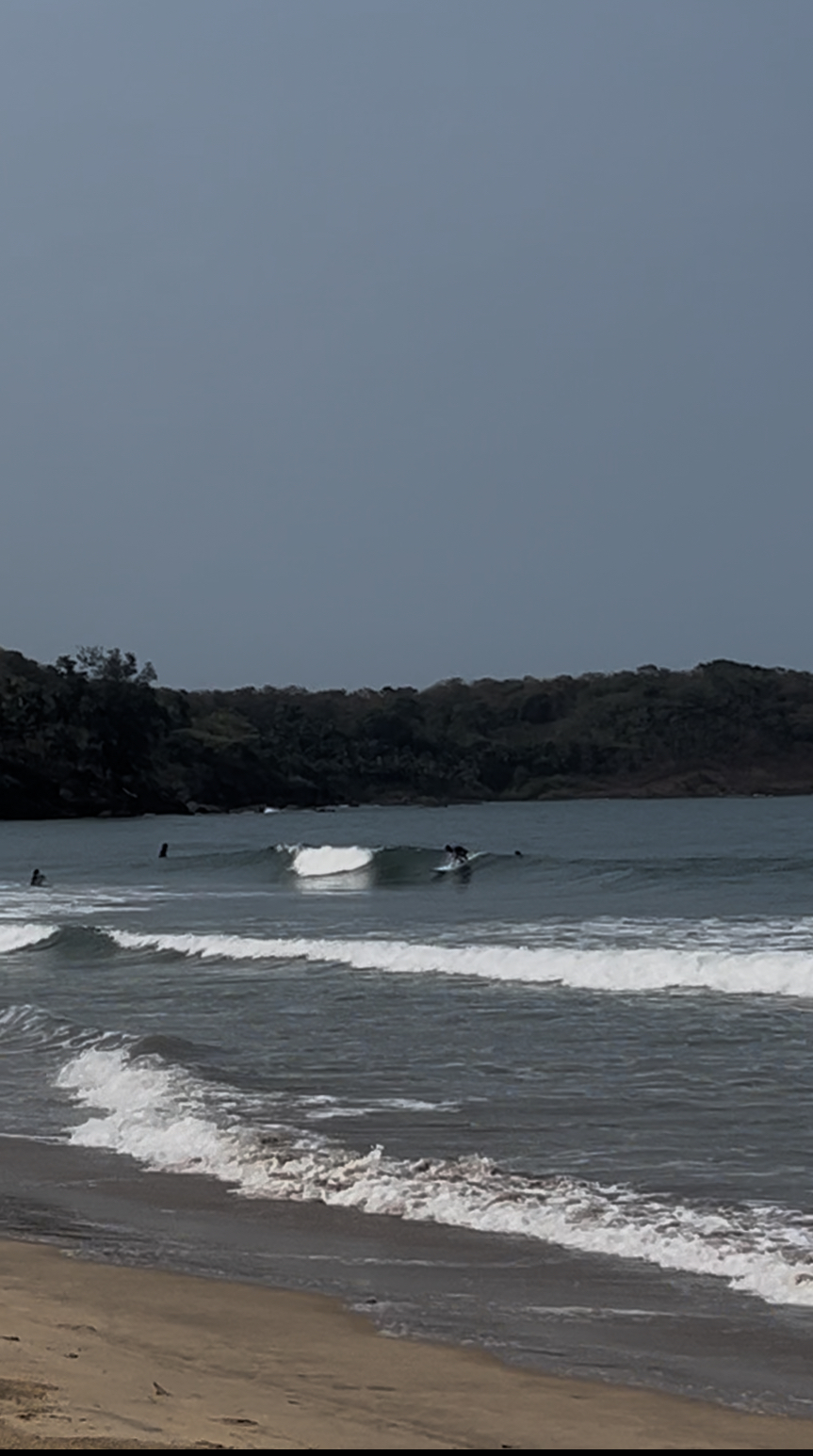
I want to go deeper on how Surfing and protecting the ocean are linked. Most of the great waves that surfers look for across the world are caused by a unique geographic structure, as discussed above, that is also likely to be full of life. I want this section to be driven by personal notes from conversations with conservationists rather than being internet research based. Side note: I took my first Surfing class in South Goa & absolutely loved it. I got knocked out by most of the waves, but managed to surf 4 waves almost till the beach. A full-body workout and more importantly, an experience that made me feel like I was part of the wave. Contact Mumu Surf Club the next time you are in South Goa, they have great teachers. Going to come back to this article when I have more stories, Cheers